Thyagarajan Kumararaja: What We Notice, What We Use
Thyagarajan Kumararaja admires a building with no film in mind. A colleague says AI can find answers on demand. So what is reading widely for?
A good film leaves me curious about the person who made it. What was going through their mind? With a few directors, I go further and try to understand how they think.
Thyagarajan Kumararaja is one of them. Aaranya Kaandam, Super Deluxe and his episode of Modern Love Chennai all fascinated me. His interviews impressed me even more than the films.
In his conversation with Sudhir Srinivasan for Cinema Express, he describes seeing a beautiful building and admiring the architect who imagined its shape. Months or years later, when he needs a design for a film, he might remember it.
I like what he says about that moment: “That’s my only thought then.” When he sees the building, he is not thinking about a film.
A couple of weeks ago, I told a senior colleague why I read things that have little to do with my work. Most days, I browse Hacker News and follow whatever catches my attention, much as Kumararaja looks at a building. But when I explained the habit, I defended it differently. I said some of it would help me later, even if I could not explain how.
That morning, I had read about a newly launched product and could imagine several uses for it in enterprise decision-making. I offered it as an example of what this habit gives me.
He pointed out that someone working on a relevant problem could search for solutions when they needed them. With an LLM helping them investigate, they might find the same product.
I didn’t disagree. But I kept thinking about the conversation.
I had found something interesting before I needed it. That alone didn’t prove I had a better way to learn. If someone else could reach the same answer through a focused search, what exactly was I defending?
A fan I had already written about
There is an example in my own story about Tamil Nadu’s engineering companies that shows both sides.
My daughter wanted the fan at full speed when she fell asleep. By one or two in the morning, she would feel cold and ask us to turn it down. Someone had to get up, so we decided to buy a fan with a remote.
The search led me to Superfan and the company behind it, Versa Drives. I read about its engineering background and bought the fan. A specific problem had led to research and a purchase that solved it.
My colleague’s approach was already there in the story.
But months before I started shopping for fans, I had watched an interview with Parthiban of Bull Machines on Nanayam Vikatan. I then looked through the company’s website, reading about construction equipment.
When I wrote about Versa Drives, I connected it with what I had learned about Bull. Different products, but a similar interest in building engineering capability over time. The fan purchase became a way to look again at companies I had barely noticed before.
I cannot credit that earlier interview with solving our bedroom problem. The remote did that. Yet the interview gave me something to recognise when I encountered another company.
This makes the disagreement with my colleague smaller and more useful. Finding an answer and recognising a connection can happen at different times. My focused search found the fan; an earlier interest helped me see something beyond the purchase.
Reading with no purpose in mind
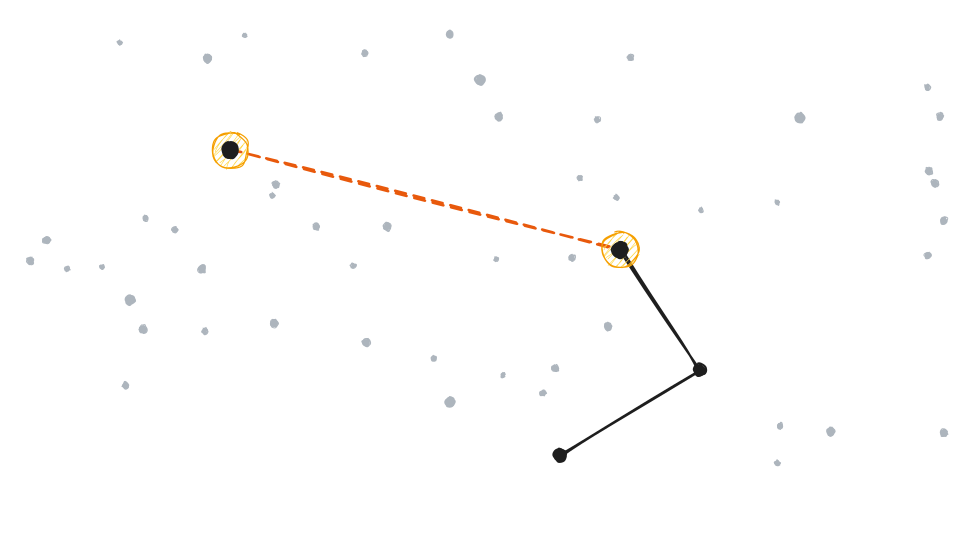
It is tempting to turn Kumararaja’s building example into advice about collecting useful influences. But that would change the pleasure of the encounter into another obligation. Some of what I read will stay with me; some will lead nowhere I can name.
Naval Ravikant’s advice about reading starts with that interest:
“Read what you love until you love to read.”
He also talks about building foundations that help us judge what we read. Following an interest can get me into a subject. Understanding it takes more than enjoying the first article.
Steve Jobs’s account of studying calligraphy is a familiar example of the time this can take. Years later, he could trace the Mac’s typography back to that course, because by then the computer existed.
That leaves a question for my own reading. I can readily describe what I have encountered. Showing what it changed is harder.
The work after noticing
Kumararaja describes that harder part in his interview with Baradwaj Rangan. He talks about bringing musical construction into filmmaking: the writing, a character’s entrance, movement and lighting. Getting those elements to fall into place takes time.
This is the part I find most interesting. Once an influence reaches a scene, it has to work with everything else in it.
The building he remembers may offer a design possibility. His sense of music may suggest how a scene should move. Neither settles every choice for him, and recognising an influence from outside filmmaking cannot tell us whether the finished scene works.
Naval puts the difficulty directly in In the Arena:
“Acquiring knowledge is easy, the hard part is knowing what to apply and when.”
In that conversation, he discusses how working on specific situations gives general advice a context. Once there is a decision to make, an idea has to meet the details of the problem.
This helps me put words to what I mean by knowledge and wisdom. Knowledge includes the things I study deliberately and the things I encounter along the way. Wisdom includes the judgment to decide what belongs in the situation before me, how far a connection holds, and what may follow from acting on it.
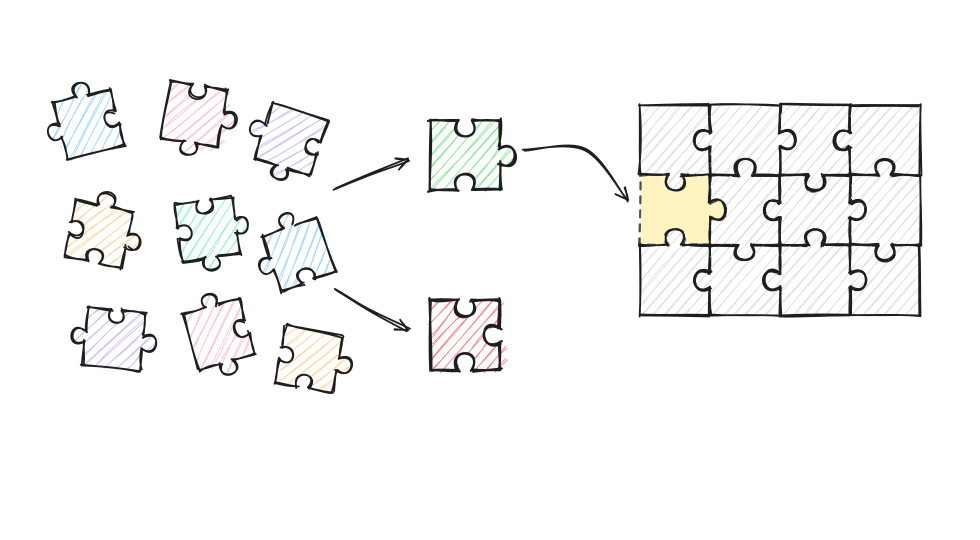
A pattern borrowed from another field can be useful. It can also make me overlook a difference that matters. Understanding enough of both situations helps me judge the comparison, and the result may still correct me.
Even my fan story has a boundary here. Recognising a resemblance between two companies gave me a subject to think and write about. It did not make me qualified to design their products or show that either company would be a good choice for every buyer.
Back to that morning’s discovery
With the product I mentioned to my colleague, I am still near the beginning. I found it, read about it and imagined uses for it. I have not tested whether any of those uses work.
The next interesting article could easily take its place. Discovery is satisfying, and another one is usually waiting before I have done much with the last.
To pursue one of those enterprise uses, I would need to study the actual requirements, try the product against them and see where my first impression fails. My colleague’s focused approach would help with that work. An LLM could help too, but I would still have to check what it found.
None of this means I should read less. The time I spent on Bull Machines had a place in my life before there was a fan to buy or a story to write. I don’t need every article to pay me back.
But when I claim that something I read will help with my work, I owe the claim more attention. Kumararaja’s love of music counts because it reaches a character’s entrance and the way a scene moves. Jobs’s calligraphy counts because it reached the Mac’s typography.
For now, that product is my building. I enjoyed finding it on an ordinary morning. Whether it ever reaches my work depends on what I do next.
Co-written with AI. Credit the prose, blame the opinions.